Aircraft Rental at Falcon Field: Everything You Need to Know About KFFZ
March 31, 2026
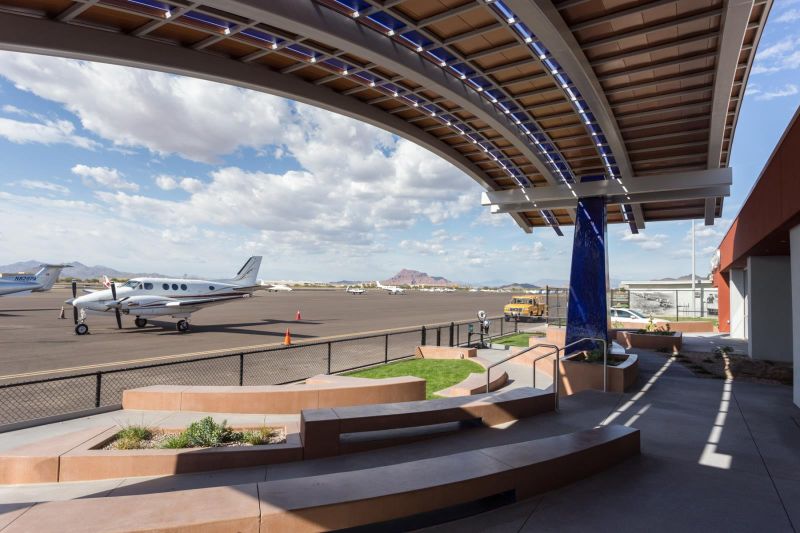
Falcon Field Airport in Mesa, Arizona is one of the most pilot-friendly general aviation airports in the Phoenix metro area. Here is what you need to know before you fly.
Most pilots outside of Arizona have not heard of Falcon Field. That changes as soon as they spend a week flying out of it.
KFFZ is a Class D towered airport with a full instrument approach, year-round VFR weather, a competent air traffic control facility, and access to some of the most varied cross-country terrain in the southwest. It also sits in the Phoenix Terminal Control Area, which means you are flying in real airspace on every flight whether you want to or not.
Kodiak Aviation is based at Falcon Field and offers aircraft rental and flight simulation to pilots at all stages of training. This post covers the airport, the airspace, the weather, and why it is a practical base for hour-building, instrument training, and general-purpose flying.
Falcon Field Airport: The Basics
Falcon Field Airport (KFFZ / FAA identifier FFZ) is a public-use general aviation airport located in Mesa, Arizona. It is owned and operated by the City of Mesa. The airport sits at an elevation of 1,394 feet MSL on the eastern edge of the Phoenix metro area.
KFFZ has two runways: Runway 4/22 at 5,101 feet, and Runway 12/30 at 3,799 feet. The longer runway handles everything from single-engine trainers to light jets without issue. The airport has a full-service control tower that operates from 0600 to 2100 local time. Outside those hours, it is CTAF operations on 119.9.
FBOs on the field include Falcon Executive Aviation, which provides fuel, and Kodiak Aviation, which provides aircraft rental and simulator access for pilots working toward certificates or building hours.
Class D Airspace at KFFZ: What That Means for Renters
Class D airspace extends from the surface to 2,900 feet MSL around Falcon Field, with a nominal radius of 4.4 nautical miles. To operate in Class D, you need a two-way radio and communication must be established with the tower before entering.
For pilots in training, this is genuinely valuable. Every single departure and arrival at KFFZ involves ATC communication. You are not going to get lazy about position reporting, readbacks, or clearance procedures when the tower is involved every time you fly. Pilots who train at uncontrolled fields and then step into a towered environment often find the transition rocky. Flying out of KFFZ eliminates that problem early.
The surrounding airspace is complex and useful. Phoenix Sky Harbor International (KPHX) Class B airspace sits to the west. Chandler Municipal (KCHD) is Class D to the southwest. Scottsdale Airport (KSDL) is Class D to the northwest. Navigating this environment requires real airspace awareness and real communication skills.
A Note on the Phoenix BRAVO
The Phoenix Class B airspace is a significant navigational feature for Falcon Field operations. Pilots flying west of KFFZ toward Sky Harbor or navigating into the downtown Phoenix area need BRAVO clearances or must remain below the floor. Learning the exact floors and ceilings of the BRAVO shelves is part of the ground briefing for every new renter at Kodiak Aviation.
Weather at Falcon Field: Why Arizona Is Ideal for Hour-Building
The Mesa and greater Phoenix area averages over 300 days of sunshine and VFR flying conditions per year. For pilots building hours, this is a practical advantage that is hard to overstate.
Compare this to training in the midwest, the northeast, or the Pacific Northwest, where persistent instrument meteorological conditions, low ceilings, and winter snowfall can ground a pilot for days or weeks at a time. Building 200 hours in Chicago takes longer and costs more in calendar time than building the same hours in Mesa because you are flying more days per year.
Summer Weather Considerations
Arizona summers require specific awareness. The monsoon season runs roughly from mid-June through September. During this period, afternoon thunderstorms can develop rapidly over the mountains and move into the valley with limited warning. Morning flying is the norm for summer operations in the Phoenix area. Pilots who fly regularly out of KFFZ during monsoon season develop genuine skill in weather interpretation and go/no-go decision-making that is not available in consistently stable environments.
Summer density altitude is also a real training variable. At Phoenix elevations and summer temperatures, density altitudes regularly reach 5,000 to 6,000 feet or higher. Takeoff roll is longer, climb rates are reduced, and airspeed management becomes more critical. This is training value that flatland pilots sometimes lack.
Winter Operations
Winters at Falcon Field are mild. Temperatures rarely drop below freezing on the field, and icing is not a routine concern at low altitudes. VFR flying through December, January, and February is the rule rather than the exception. This makes KFFZ a destination for pilots from cold-weather states who want to compress their hour-building into a winter trip without being grounded by ice.
Cross-Country Options from KFFZ
Part of what makes Falcon Field a strong base for hour-building is the range of destinations accessible within a two-hour flight:
- Sedona Airport (KSEZ) — Class G uncontrolled, canyon approaches, high-elevation terrain. 89 nm. Exceptional scenery and legitimately challenging approaches for currency building.
- Prescott Regional (KPRC) — Class D, 5,045 ft elevation, regular density altitude training. 89 nm northwest. A favorite destination for high-altitude operations work.
- Tucson International (KTUS) — Class C, 80 nm south. Good exposure to busy Class C communications and commercial traffic in the pattern.
- Flagstaff Pulliam (KFLG) — Elevation 7,014 ft MSL, 119 nm north. Mountain terrain, high-density altitude, and winter weather variables. An excellent advanced cross-country.
- Phoenix-Mesa Gateway (KIWA) — Class D, 22 nm southwest. Formerly Williams Air Force Base, now a commercial reliever field. Quick hop for tower communication practice.
Instrument Approaches Available at KFFZ
For pilots working on instrument ratings or maintaining IFR currency, Falcon Field is well equipped. Published instrument approaches include the ILS/LOC RWY 4, the RNAV (GPS) RWY 4, the RNAV (GPS) RWY 22, and the RNAV (GPS) RWY 30.
The ILS on Runway 4 is a precision approach, making KFFZ one of the few general aviation fields in the Phoenix area with a full precision instrument approach. Logging ILS practice in actual IMC or under the hood is part of routine training at Kodiak Aviation.
“Falcon Field was a deliberate choice for this operation. The airspace, the instrument approaches, the year-round flying weather, and the cross-country options all work together to give pilots a training environment that is genuinely representative of what they are going to face as working pilots. You are not training in a vacuum here.” — Kodiak Aviation, Falcon Field
Renting at Falcon Field: What the Process Looks Like
New renters at Kodiak Aviation complete a brief checkout process before flying solo. For the SR20 G6, this includes a systems review and a checkout flight covering Falcon Field operations, SR20 emergency procedures, and the Garmin Perspective+ avionics suite.
After checkout, scheduling is handled directly through Kodiak. You book the aircraft for the hours you need, you fly your profile, and you log your time. There is no enrollment process, no mandatory curriculum, and no artificial restrictions on how you use your flight time beyond the requirements of your certificate and the aircraft POH.
Plan Your Next Flight from Falcon Field
Kodiak Aviation is located at Falcon Field Airport in Mesa, Arizona. Aircraft rental in the Cirrus SR20 G6 at $285/hr wet. FAA-certified flight simulator at $100/hr. 15 and 30-hour hour-building packages available.
Book a Checkout or Rental Flight | kodiakaviation.com | Falcon Field Airport (KFFZ), Mesa AZ<
FAA-Certified Flight Simulator: What ‘Loggable Hours’ Really Means
READ STORY